



How to Compare Warehouse Lighting Retrofit Quotes: A Bid-Leveling Checklist
A lower fixture price does not necessarily make a lower-cost warehouse lighting proposal. One quote may include a photometric layout, controls, lift rental, disposal, commissioning, and model-specific documentation. Another may include only fixtures and a broad promise to replace the existing lights one for one.
Before comparing totals, force every bidder onto the same scope. The practical question is not “Which quote is cheapest?” It is “Which quote delivers the required lighting result, with the fewest unpriced assumptions left for the owner?”
This guide provides a bid-leveling method for warehouse owners, facility managers, contractors, and purchasing teams. It does not select a contractor or approve an electrical design. It helps you identify what is included, what is missing, and which differences require technical review before award.

Start with one written project scope
Bid leveling fails when each supplier is pricing a different version of the project. Issue one scope sheet before requesting final quotes. At minimum, it should define:
- the zones included in the project;
- existing fixture quantities and technologies by zone;
- mounting height and usable mounting locations;
- rack rows, aisles, workstations, docks, and major obstructions;
- the tasks performed and the agreed lighting criteria;
- operating schedule by zone;
- available voltage and existing controls;
- environmental conditions that affect fixture suitability;
- required installation window and access restrictions;
- the documents and closeout items expected with the quote.
If these inputs are incomplete, use the warehouse lighting site-survey checklist before comparing prices. A bid cannot be normalized if the bidders were given different facts.
Apply five pass-or-review gates before scoring price
Some omissions should not be offset by a low price. Mark each proposal pass, needs clarification, or not provided for these five gates:
- Exact product identity: The quote names the manufacturer, complete model or ordering code, selected wattage/output, CCT, optic, voltage, mounting, controls, and accessories.
- Lighting evidence: The proposal includes a project-specific photometric layout or clearly states that the price is preliminary until one is approved.
- Application fit: Environmental, mounting, electrical, and control requirements are matched to model-specific documentation.
- Installation scope: Labor, lifts, shutdowns, removal, disposal, patching, permits, commissioning, and exclusions are itemized.
- Commercial accountability: Warranty process, lead time, freight, damage claims, substitutions, spares, and closeout documents are defined.
Compare exact fixture configurations—not product-family names
“150W high bay” is not a complete specification. Two products with the same nominal wattage can have different lumen output, distribution, dimming behavior, mounting hardware, environmental ratings, and documentation.
Create one row for every proposed configuration. Record the exact source for each value rather than copying claims from a product title. If a fixture has selectable wattage or CCT, the quote must state the setting used in the layout and energy calculation.
| Fixture item | What the quote must identify | Evidence to request |
|---|---|---|
| Product | Manufacturer and complete model/order code | Current spec sheet and ordering guide |
| Output | Selected watts and delivered lumens | Model-specific photometric report or data |
| Distribution | Lens, reflector, optic, or distribution code | IES file used in the project layout |
| Electrical | Input voltage, dimming, cord/lead, plug, and surge option | Driver label, manual, and wiring diagram |
| Mechanical | Mounting method, safety cable, guards, and accessories | Installation instructions and accessory list |
| Qualification | Required safety, efficiency, or rebate listing for the exact model | Directory/QPL record and certificate scope |
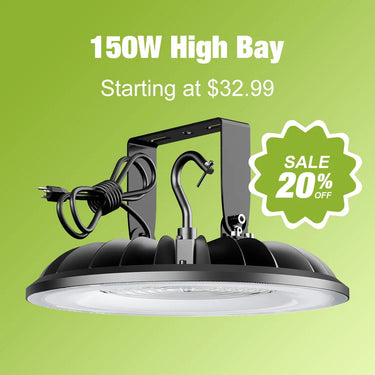
The current YXL HB Series UFO High Bay page illustrates why the exact configuration matters. Its purchasable variants are labeled 150W/24,000 lm, 200W/32,000 lm, 240W/36,000 lm, and 300W/42,000 lm at 5000K. The linked HB Series specification sheet, however, identifies selectable settings for each fixture and lists maximum delivered lumens of 22,500, 30,000, 36,000, and 45,000 lm respectively. Because the storefront labels and specification sheet do not agree for three of the four full-output variants, a proposal should not rely on the family title alone. Require the complete SKU, selected setting, and the photometric file used for the layout.
The same documents confirm several model-family details that belong in the submittal: 100–277V input, 0–10V dimming, IP65, a stated operating range of −31°F to 122°F (−35°C to 50°C), and hook mounting with a set screw and safety rope shown in the installation instructions. These facts help define the quote, but they do not replace model-specific certification and photometric verification.
Compare the proposed lighting result
A proposal with fewer fixtures is not automatically more efficient or better designed. Ask each bidder to report the same calculation planes and metrics for the same operating zones.
- fixture count and mounting height by zone;
- average, minimum, and maximum maintained illuminance;
- the uniformity metric requested by the project team;
- workplane height and calculation-grid settings;
- light loss factor and other stated assumptions;
- rack, shelf, equipment, and ceiling obstructions included in the model;
- the exact IES file used for every luminaire type;
- emergency or special task areas excluded from the base layout.
Do not compare one bidder’s initial light levels with another bidder’s maintained values. Do not compare open-floor calculations with a model that includes full-height racks. If the reports do not share the same basis, return them for clarification.
YXL’s lighting layout service can turn a dimensioned plan, mounting height, rack arrangement, tasks, voltage, and selected fixture into a project-specific layout for review.
Separate controls from the base lighting system
Controls can change operating energy and project cost without changing the full-output lighting requirement. Compare the lighting system and the control strategy as two connected scopes.
For every controlled zone, document the sensor type, control interface, coverage, mounting limits, occupied level, standby level, timeout, daylight behavior, override, commissioning work, and responsibility for final settings. “Sensor included” does not answer those questions.
If one quote assumes controls savings and another does not, first compare the uncontrolled fixture energy on common hours. Then show the controls scenario separately with its assumptions. This keeps an aggressive occupancy estimate from disguising a higher connected load.
Level the installation scope line by line
Warehouse retrofit pricing often moves more because of access and exclusions than because of the fixture price. Require bidders to state whether each item is included, excluded, or an allowance:
- lift type, rental period, delivery, and operator;
- after-hours work, shutdown coordination, and occupied-area protection;
- removal of existing fixtures, lamps, ballasts, whips, and brackets;
- disposal or recycling;
- new junction boxes, cords, plugs, whips, conduit, or branch-circuit changes;
- mounting adapters, chains, pendants, safety cables, and guards;
- control wiring, sensors, gateways, programming, and acceptance testing;
- permits, inspections, tax, freight, storage, and damaged-shipment handling;
- patching, ceiling repair, labeling, as-built drawings, and training;
- unit rates for concealed conditions or added work.
Electrical work, code interpretation, and installation planning should be handled by qualified professionals familiar with the facility and local requirements.
Recalculate energy on common assumptions
Do not accept two different utility rates, operating schedules, or control-savings estimates in the same comparison. Recalculate every option using one owner-approved baseline.
Illustrative comparison: Proposal A uses 24 fixtures at a selected 150W setting. Proposal B uses 20 fixtures at 200W. At an assumed 4,000 full-output-equivalent hours:
- Proposal A: 24 × 150W × 4,000 ÷ 1,000 = 14,400 kWh/year
- Proposal B: 20 × 200W × 4,000 ÷ 1,000 = 16,000 kWh/year
This arithmetic does not determine which layout is acceptable. Proposal B may or may not meet the same lighting criteria, and Proposal A may or may not provide suitable uniformity. The photometric comparison comes first; the common energy calculation compares acceptable alternatives.
For cost comparison, multiply annual kWh by the same blended electricity rate. Keep demand charges, maintenance, incentives, financing, and tax effects in separate rows unless the project’s financial reviewer has defined a shared method.
Compare commercial terms and support
A long warranty headline is less useful than a clear claim process. Ask who receives the claim, what documentation is required, which costs are covered, whether labor is excluded, how replacements are shipped, and how discontinued models are handled.
Also normalize:
- quote validity and price-adjustment terms;
- lead time and whether it begins at order, approval, or deposit;
- freight terms and delivery location;
- payment milestones and retainage, if applicable;
- approved substitutions and change-control process;
- recommended spare quantity and price;
- submittal, sample, mockup, and approval milestones;
- closeout package and responsible contact after installation.
Where rebate eligibility matters, verify the exact proposed model in the applicable program or qualified-products database. The DesignLights Consortium maintains a Qualified Products List for commercial LED lighting, but a product-family statement is not a substitute for confirming the quoted model and program requirements.
Use the bid-leveling worksheet
Copy the table below into your procurement workbook. Add one column for each proposal and require a source or page reference for every answer.
| Comparison row | Owner’s common basis | Proposal response | Status / clarification |
|---|---|---|---|
| Zones and fixture count | Approved scope and plan revision | ||
| Exact fixture configuration | Model, setting, optic, mounting, control | ||
| Photometric result | Same zones, planes, criteria, and assumptions | ||
| Connected load | Fixture count × selected watts | ||
| Annual energy | Common hours and control assumptions | ||
| Fixture and controls price | Materials subtotal with accessories | ||
| Installation | Labor, access, disposal, commissioning, permits | ||
| Freight, tax, and allowances | Owner-defined inclusions | ||
| Warranty and support | Written process and coverage | ||
| Exceptions and owner risk | All unresolved items |
Ask these questions before award
- Which exact fixture configuration and IES file were used in the final layout?
- Which lighting criteria are design requirements, and which values are only estimates?
- Are the reported results initial or maintained, and what light loss factor was used?
- What changed from the owner’s issued scope?
- Which labor, access, disposal, controls, and closeout items are excluded?
- Which energy assumptions came from the owner, and which came from the bidder?
- What model-specific documents will be submitted before release?
- What must be approved before production, shipment, or installation begins?
- Who owns commissioning, punch-list correction, and warranty claims?
- What is the price and schedule impact of every unresolved exception?
A disciplined bid comparison does not eliminate professional judgment. It makes that judgment visible. Once every bidder is working from the same scope, layout criteria, product identity, operating assumptions, and installation boundaries, price becomes meaningful—and the remaining risks can be assigned before the purchase order is issued.
Sample Image Gallery


