



How Many Spare High Bay Lights Should a Warehouse Keep?
Do not choose a high-bay spare quantity from a percentage alone. Start with the number of replacements your facility is likely to need during the supplier's replenishment lead time. Then compare that number with the largest outage your operation needs to recover from before a new order could arrive.
For one warehouse, that may justify no on-site spare. For another, two dark fixtures over a packing line may make two exact replacements non-negotiable. The useful answer comes from service risk, not folklore.
Choose one of three reserve paths
A spare fixture is insurance against a dark zone and a delayed replacement. Insurance has a carrying cost, so begin by choosing the service path that fits the facility.
| Reserve path | When it can make sense | What must be documented |
|---|---|---|
| Order on demand | A single outage has low operational impact, temporary coverage is acceptable, and confirmed replenishment is fast. | Supplier, exact configuration, current lead time, approved substitution process, and who places the order. |
| Keep a small on-site reserve | Dark locations disrupt picking, packing, inspection, loading, or safe movement before replenishment can arrive. | Reserve quantity, protected storage location, issue log, reorder point, and exact model record. |
| Use a supplier or regional reserve | Several sites share a standardized fixture and can move stock faster than each site can justify its own shelf inventory. | Ownership, response time, allocation rules, shipping path, and configuration control. |
“The supplier carries it” is not a reserve plan unless quantity, configuration, location, and response time have been confirmed. Likewise, a box on a shelf is not useful if nobody can identify which installed fixtures it matches.
Calculate demand during replenishment lead time
If the facility has credible maintenance records, use them. Count corrective fixture replacements for the exact product family during a representative period. Do not mix cleaning, wiring repairs, sensor adjustments, impact damage, and full-fixture replacements into one number.
Starting formula
Demand during lead time = annual corrective replacements × replenishment lead time in days ÷ 365
Round the result up to a whole fixture, then t est it against the outage-recovery floor in the next section. The formula estimates exposure; it does not predict a product's reliability or replace warranty analysis.
Worked example with explicit assumptions
- 120 installed high bays of one exact configuration;
- 3 full-fixture corrective replacements recorded in the last 12 months;
- 45 calendar days from approved purchase order to receipt;
- no known redesign, abnormal damage event, or change in operating conditions.
3 × 45 ÷ 365 = 0.37 fixture
Rounding up gives a lead-time reserve of one fixture. That is only the first answer. If the warehouse needs to restore two simultaneous outages before a delivery could arrive, one spare is not enough.
If there is no usable replacement history, do not invent a failure rate. Use the outage-recovery floor, current lead time, maintenance access, and supplier support to set a temporary reserve. Start recording withdrawals immediately and revisit the decision after a defined review period.
Set the outage-recovery floor
The outage floor is the number of fixtures the site may need to replace before replenishment arrives. It is driven by consequence, not square footage.
Ask the operations and maintenance teams to mark each zone:
- Critical: An outage can stop or materially restrict a task, create an unacceptable dark location, or require immediate temporary lighting.
- Important: One outage is tolerable briefly, but a second outage in the same zone triggers corrective work.
- Routine: Work can continue within the approved lighting and safety plan until a normal order arrives.
For the example above, assume the owner decides that two simultaneous outages in critical picking and packing zones must be recoverable. The outage floor is two. Compare the two calculations:
- lead-time demand rounded up: 1 fixture;
- outage-recovery floor: 2 fixtures;
- initial on-site reserve: 2 fixtures.
This is a planning result, not a blanket recommendation for every 120-fixture warehouse. A remote site with a long delivery route may choose more. A site with local confirmed stock and acceptable temporary coverage may choose less.
Define what an exact replacement means
“Same wattage” is not enough. A usable spare must fit the installed design and service method. Record the complete ordering configuration, including:
- manufacturer and full SKU or ordering code;
- fixture family and physical size;
- selected wattage or output setting;
- color temperature setting;
- optic or beam distribution;
- input voltage and driver/control configuration;
- motion sensor, remote, or control accessories;
- mounting hardware, cord, plug, and safety-cable requirements;
- environmental rating required by that exact zone;
- manual, specification sheet, photometric file, and purchase revision.
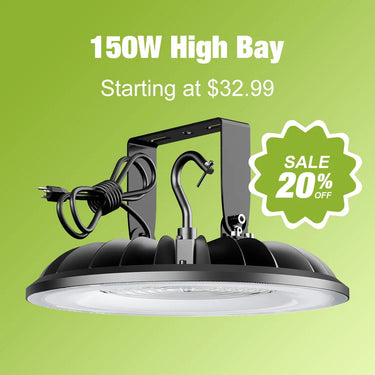
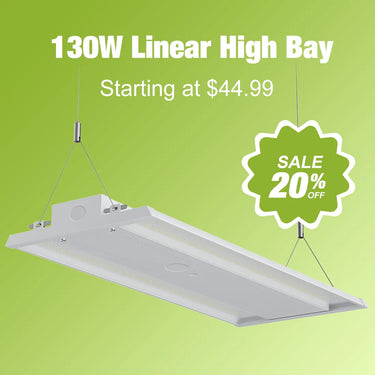
YXL's current high-bay product family includes multiple wattages and configurations. That flexibility makes the ordering record more important, not less. A spare that looks similar can still have the wrong output, controls, mounting, or electrical configuration.
Do not assume that a replacement from a later product revision is photometrically interchangeable. If the original is unavailable, compare the exact proposed substitute and update the lighting record before installation.
Build one fixture record card
Attach a printed copy to the spare and keep the same record in the maintenance system. A phone photo of an old carton is not a durable asset register.
| Record field | What to enter | Why it matters |
|---|---|---|
| Installed zones | Building, aisle, row, or work-area IDs | Shows where the spare is approved for use. |
| Exact configuration | SKU, watts, CCT, optic, voltage, controls, mounting | Prevents a visually similar but incompatible substitution. |
| Source documents | Manual, spec sheet, photometric file, approved submittal | Preserves the basis for installation and acceptance. |
| Commercial record | PO, receipt date, supplier, warranty contact | Supports traceability and service requests. |
| Inventory control | Storage location, reserve quantity, reorder point, owner | Turns the spare into a maintained system rather than forgotten stock. |
Store, issue, and reorder correctly
Keep the fixture in a clean, dry location within the manufacturer's storage limits. Protect the lens, cord, controls, and mounting parts. Do not stack or suspend boxes in a way that can damage the housing or accessories.
Every withdrawal should create a maintenance record with the date, installed location, reason for replacement, failed unit identification, and person responsible for the reorder. If a reserve of two falls to one, the reorder should begin then—not after the last spare leaves the shelf.
A simple review every six to twelve months should answer four questions:
- How many full fixtures were actually issued?
- Were failures concentrated in one zone or caused by impact, heat, moisture, controls, or electrical conditions?
- Did actual replenishment take longer or shorter than planned?
- Has the installed model, revision, layout, or supplier support changed?
If withdrawals rise unexpectedly, adding boxes to the shelf is not the first diagnosis. Investigate the failure pattern and operating conditions.
Use this checklist before releasing the order
- List installed quantity by exact configuration—not only by product family.
- Separate critical, important, and routine zones.
- Calculate demand during current replenishment lead time when valid records exist.
- Set the simultaneous-outage floor with operations and safety stakeholders.
- Choose the larger of the calculated demand and outage floor.
- Confirm whether the reserve will be on site, regional, or supplier-held.
- Verify storage conditions and include all required mounting/control accessories.
- Create a fixture card, withdrawal log, reorder point, and named inventory owner.
- Keep future expansion quantities separate from maintenance spares.
- Review the decision after six to twelve months of actual use.
If you are still selecting fixtures, send YXL the floor plan, mounting height, rack layout, work zones, operating schedule, existing electrical information, and proposed configuration. A project-specific lighting layout review should be completed before the spare quantity is locked to an unapproved fixture schedule.
The defensible answer is rarely “always five percent.” It is the smallest controlled reserve that can cover expected demand and the warehouse's accepted outage risk until a verified replacement arrives.
Sample Image Gallery


