



Replacing 400W Metal Halide High Bays? Build the Evidence Before You Buy
A 400W metal-halide label tells you what lamp was specified. It does not tell you the complete fixture input, how much useful light reaches the work, or which LED distribution fits the space.
That is why “What wattage LED replaces 400W metal halide?” has no responsible one-number answer. A 150W LED may belong on the shortlist in one open warehouse and be wrong in a tall aisle, under a crane, or where the existing grid leaves dark bands.
The practical job is to close five evidence gaps before a purchase order: existing input, current performance, candidate output, distribution and controls, and the cost model.

Gate one: identify the old system, not just the lamp
Start at the fixture and panel records. Where safe access is available, photograph the lamp and ballast labels. Record luminaire type, voltage, mounting method, quantity, switching pattern, and mounting height above the relevant workplane. Electrical inspection and measurements belong to a qualified electrician.
Lamp watts and system input are not the same thing. The ballast is part of the load, and ballast types differ. Use luminaire or ballast documentation—or a qualified person’s measurement—instead of adding a generic percentage from a conversion chart.
| Existing-system field | Acceptable evidence | Why it matters |
|---|---|---|
| Complete fixture input | Ballast/luminaire record or qualified measurement | Sets the energy baseline |
| Lamp and ballast type | Clear label photos and catalog data | Clarifies warm-up, restrike, maintenance, and removal scope |
| Mounting height and grid | Dimensioned plan plus field check | Controls distribution, spacing, and access |
| Reflector and lens condition | Dated photos by representative zone | Explains why nameplate lumens may not match current performance |
A proposal that says only “400W MH” has not established the baseline. That is why apparently simple retrofit quotes can be impossible to compare: each vendor may be solving a different, mostly unstated problem.
Gate two: record what the room does now
Do not measure only below the brightest surviving fixture. Create a repeatable grid at the task plane, record readings between fixtures and near boundaries, and note which lamps are new, aged, dirty, cycling, or failed. Add vertical readings where people read rack labels or inspect stored material.
Keep the operating conditions with the numbers:
- date, time, daylight condition, and open-door condition;
- meter identification and measurement plane;
- which fixtures were operating and how long they had warmed up;
- rack, machinery, mezzanine, duct, crane, and tall-load positions;
- the task performed in each zone and any known complaints.
The existing average is not automatically the target. A poor system should not become the design brief merely because it is measurable. Define the intended criteria for each task, then use the baseline to show what must improve and what should not get worse.
Gate three: screen LED output without declaring a winner
YXL’s selectable-wattage/CCT specification revised October 27, 2025 lists the configurations below. They are useful candidate outputs—not universal metal-halide equivalencies.
| YXL nominal model | Selectable input | Maximum listed output | Still verify |
|---|---|---|---|
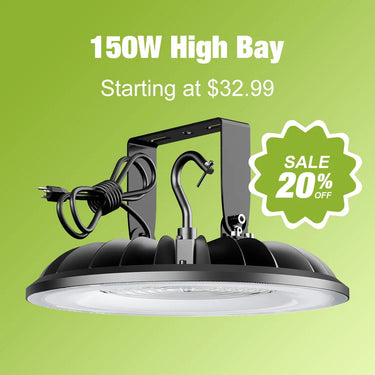
| 150W | 150W / 120W / 90W | 22,500 lm | Grid, height, criteria, uniformity, obstructions |
| 200W | 200W / 160W / 120W | 30,000 lm | Higher lumens do not repair poor distribution |
| 240W | 240W / 190W / 140W | 36,000 lm | Glare, spacing, vertical light, setting by zone |
The same specification lists 100–277V input and 0–10V dimming for these models. Confirm the exact ordered configuration and current documents in the product page’s DOWNLOAD section before releasing an order.
Shortlist rule: keep every candidate that can plausibly meet the task criteria in a photometric model. Reject a candidate because the layout fails—not because an online chart assigned one LED wattage to every 400W HID fixture.
Gate four: check the light pattern and operating plan
Lumens describe quantity leaving the luminaire. They do not show where the light lands. U.S. Department of Energy retrofit guidance warns that distribution can create glare, uneven task levels, or insufficient light on vertical surfaces, and recommends detailed calculations or measurements from a mock-up.
- Open floor
- Check the whole grid, boundaries, and work cells—not only points directly below fixtures.
- Rack aisles
- Model racks at intended height and check the vertical surfaces people read.
- Low mounting
- Review high-angle brightness and glare before assuming more lumens help.
- Obstructed bays
- Include ducts, cranes, conveyors, mezzanines, and tall stored loads.
Then define operation. Are zones switched together? Is 0–10V dimming actually wired and controlled? Would occupancy sensing reduce full-output hours in intermittently used aisles? Do not count a controls option as savings until the sequence, coverage, settings, and expected occupied hours are documented.
Gate five: run the cost comparison with visible assumptions
Use input watts for the complete old and new systems. Keep fixture quantity, operating hours, controls, demand charges, labor, lift access, disposal, and rebate assumptions on separate lines so a reviewer can challenge them.
Annual lighting energy
fixture quantity × input kW per fixture × annual full-output-equivalent hours
Use full-output-equivalent hours when controls dim or switch the system. Calendar operating hours alone will overstate controlled energy use.
A screening example—not a project result
Assume 24 fixtures, 455W documented total input per existing fixture, a YXL 150W candidate at its full setting, and 4,000 annual full-output-equivalent hours.
- Existing: 24 × 0.455 kW × 4,000 hours = 43,680 kWh/year
- Candidate: 24 × 0.150 kW × 4,000 hours = 14,400 kWh/year
- Screened difference: 29,280 kWh/year
Multiply the difference by the facility’s applicable energy rate to estimate the energy-cost difference. Do not call it “savings” yet. First confirm that the proposed count, output, and distribution satisfy the layout and that the assumptions represent actual operation.
If the photometric design needs a different fixture count or setting, rerun the model. The lighting plan gets to change the spreadsheet. The spreadsheet does not get to overrule the lighting plan.

The one-for-one decision
A one-for-one retrofit survives only when all five statements are true:
- The existing system input and condition are documented.
- The owner’s task criteria are defined by zone.
- The proposed fixture configuration is identified, not just the family.
- A photometric calculation or representative mock-up shows acceptable levels, distribution, and glare.
- The cost model uses the resulting count, settings, controls, and realistic hours.
If the grid changes, treat the project as a redesign. If racks or tasks change, model the future condition. Selectable wattage can preserve commissioning flexibility, but it is not permission to skip the layout.
For a project-specific YXL lighting layout review, send the dimensioned plan, fixture grid, mounting height, rack and obstruction information, task locations, existing-system record, voltage, control intent, and the exact YXL high-bay configuration you want evaluated.
Sample Image Gallery


